
Therapy for Relationship Issues in NYC

We All Have Relationship Issues
I help individuals and couples in Midtown Manhattan work through relationship issues involving conflict, emotional distance, dating struggles, repeated misunderstandings, family tension, and patterns that do not seem to change. I also work with clients throughout New York State by telehealth.
Relationships can bring joy, growth, and a sense of belonging, but they can also become painful, confusing, and exhausting. Difficulties may arise in romantic relationships, families, friendships, or work settings, and they often carry more emotional weight than people expect.
Marital or premarital tensions, breakups, family conflicts, or workplace friction can continue for months, years, or even a lifetime when the deeper patterns are not yet clear.
While advice from friends or quick fixes in books can help in the short term, they rarely uncover the deeper patterns that keep problems in place. Sometimes the real challenge is not only what is happening between you and another person, but how each of you is perceiving and interpreting it.
How Perceptions Shape Relationships
Every relationship is its own ecosystem, shaped by unspoken expectations, personal histories, and private definitions of what love and partnership should look like. You may see yourself as someone who protects others’ feelings, seeks intellectual connection, or depends on your partner to ease loneliness.
Your partner, in turn, has their own internal map, often just as complex. The question is: how well do you truly know each other’s maps? Are you navigating the same terrain, or living in parallel worlds of assumption?
When Assumptions Go Too Far
One common trap is Projective Mystification, the belief that you know your partner better than they know themselves (Werner et al., 2001). It can feel insightful, even caring, but in reality it often leads to misinterpretations, frustration, or co-dependence.
Research shows that higher Perceptual Agreement, the degree to which partners accurately grasp each other’s inner world, strongly predicts a more satisfying relationship. The more we assume and misread, the less perceptual agreement we have with our partners, and the more relationship quality tends to suffer (Ivanov & Werner, 2018).
Imagine meeting your partner anew, not as you think they are, but as they truly experience themselves. That shift in perception can change the entire emotional climate of a relationship.
And yet, even with the best intentions, many couples struggle to make that shift. The numbers tell a clear story.
Relationship Reality Check
- First marriages in the U.S. last, on average, about 8 years before ending in divorce or separation (Raley, Sweeney, & Wondra, 2015).
- Roughly 40–50% of first marriages ultimately end in divorce, with higher rates for subsequent marriages (Amato, 2010; Kennedy & Ruggles, 2014).
- About half of marriages may involve low satisfaction—in a national survey of 59,379 married couples from all 50 states, approximately 35% were classified as “happily married,” about 35% as “unhappily married,” and the remaining 30% gave moderate satisfaction ratings or had markedly different ratings from their partner (Olson, Olson-Sigg, & Larson, 2008).
From the National Survey of Married Couples (U.S.)
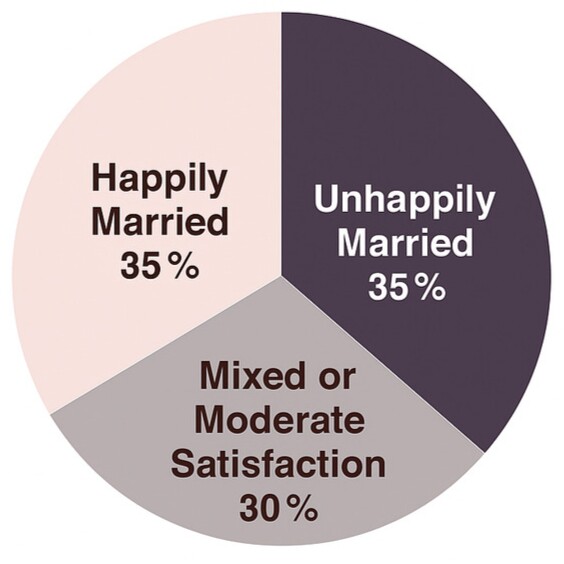
These numbers point to a simple reality: relationship difficulties are common, and they can affect anyone, regardless of love, commitment, or good intentions.
Why Relationship Problems Develop
Relationship strain rarely has a single cause. More often, it grows from a mix of factors that interact over time:
- Communication breakdowns – What begins as small misunderstandings can turn into patterns of criticism, defensiveness, or withdrawal. When these habits take root, even minor issues become hard to resolve.
- Unmet emotional needs – Feeling unseen, unsupported, or undervalued chips away at connection. Over time, partners may begin to protect themselves from further hurt by withdrawing emotionally.
- Life transitions and stressors – Big changes often test a relationship’s stability. Moving in together, becoming parents, changing careers, relocating, or coping with illness can unsettle established routines and surface hidden differences in needs or expectations.
- Attachment styles – The ways we learned to seek comfort or protect ourselves in early relationships often reappear in adult partnerships, shaping how we express needs, respond to conflict, and pursue closeness.
- Unresolved personal challenges – Depression, anxiety, trauma, or substance use can spill over into a relationship, adding strain even when both partners are committed to making it work.
Treatment Options
Couples may seek help through a variety of approaches, including:
Behavioral and skills-based models
These approaches include communication skills training and structured problem-solving, aimed at improving day-to-day interactions and reducing conflict.
Emotionally Focused Therapy (EFT)
EFT emphasizes strengthening attachment bonds by helping partners understand and respond to each other’s emotional needs more effectively.
The Gottman Method
This method focuses on friendship, conflict management, and building shared meaning as foundations for a lasting relationship.
Psychodynamic or systems approaches
These approaches explore deeper patterns, family-of-origin influences, and how larger relational systems affect the couple’s dynamics.
Each approach offers valuable tools for change, but not all directly address the subtle perceptions and interpretations that shape how partners understand each other.
How I Can Help
I draw on extensive experience with many of the approaches above, but my current work centers on Consensus Therapy, a model I developed to help couples move beyond assumptions and understand each other more accurately. Many relationship problems are fueled not only by differences in values, habits, or communication style, but also by misperceptions about what a partner truly feels, needs, or intends.
Map and clarify each partner’s perceptions
Uncover the ways each partner interprets the other’s emotions, needs, and intentions, bringing hidden assumptions into the open.
Identify and reduce distortions
Recognize the misunderstandings that lead to conflict or withdrawal and work together to correct them.
Build a shared, reality-based understanding
Develop a more accurate and mutually agreed-upon view of the relationship that respects both partners’ perspectives.
Strengthen emotional safety and mutual respect
Establish a foundation where both partners feel secure, valued, and understood, creating space for deeper connection and resilience.
While my Couples Therapy page describes the process in more detail, my goal here is simple: to help you replace disconnection with clarity, empathy, and renewed closeness.
If you are looking for help with relationship issues in NYC, I offer in-person sessions in Midtown Manhattan as well as telehealth throughout New York State. You may also want to learn more about couples therapy, individual psychotherapy, anxiety, or request an appointment.
References
Amato, P. R. (2010). Research on divorce: Continuing trends and new developments. Journal of Marriage and Family, 72(3), 650–666.
Ivanov, M., & Werner, P. (2018). Perceptual agreement: Assessing reality and illusion in romantic relationships. Couple and Family Psychology: Research and Practice, 7(2), 76–90. http://dx.doi.org/10.1037/cfp0000101
Kennedy, S., & Ruggles, S. (2014). Breaking up is hard to count: The rise of divorce in the United States, 1980–2010. American Sociological Review, 79(2), 310–332.
Olson, D. H., Olson-Sigg, A., & Larson, P. J. (2008). The National Survey of Married Couples. Minneapolis, MN: Life Innovations.
Raley, R. K., Sweeney, M. M., & Wondra, D. (2015). The growing racial and ethnic divide in U.S. marriage patterns. The Future of Children, 25(2), 89–109.
Werner, P. D., Green, R.-J., Greenberg, J., Browne, T. L., & McKenna, T. E. (2001). Beyond enmeshment: Evidence for the independence of intrusiveness and closeness-caregiving in personal relationships. Journal of Social and Personal Relationships, 18(1), 29–52.
If you plan on being anything less than you are capable of being, you will probably be unhappy all the days of your life.
- Abraham Maslow, Toward a Psychology of Being (1968)
Reach Out