
Narcissistic Traits in Intimate Relationships
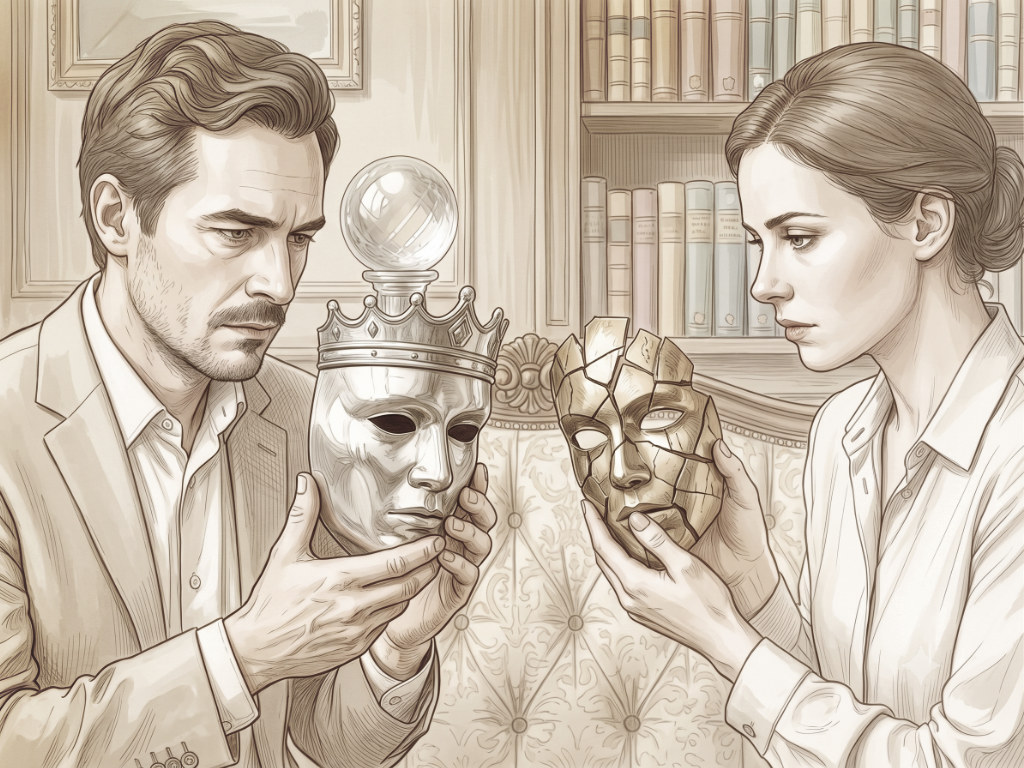
Narcissistic Dynamics in Relationships: Beyond Diagnosis
People often come to therapy asking whether their partner is "narcissistic" or "borderline." Usually, that question cannot be answered responsibly from a distance. A more clinically useful question is how certain personality traits, defensive patterns, and early relational injuries shape the way people choose partners, seek reassurance, manage shame, and respond to emotional disappointment.
This article focuses mainly on narcissistic dynamics, while using borderline traits as a point of contrast. It addresses traits and relational patterns, not diagnosis. Not every self-centered, avoidant, defensive, or emotionally unavailable partner has narcissistic personality disorder (NPD). Narcissistic and borderline traits exist on a continuum and can occur in both partners. Only a qualified clinician can diagnose a personality disorder after proper assessment. The practical issue is not simply "What is wrong with my partner?" but "What pattern are we co-creating, tolerating, repeating, or misperceiving?"
Early Emotional Injuries and Narcissistic Defenses
Early emotional experiences leave a lasting imprint on memory, forming internal models that influence how we perceive and engage in future relationships (Stern, 1985). When caregivers consistently fail to meet a child's emotional needs, this can cause emotional injuries. In response, the child develops defensive patterns that become embedded in their internal relational models and later shape how the individual selects, approaches, and interprets intimate relationships (Solomon, 1994).
In some psychoanalytic formulations, borderline and narcissistic defenses differ in how the other person is experienced under stress. Borderline dynamics often involve intense fear of abandonment, emotional dysregulation, and unstable representations of self and other, whereas narcissistic dynamics may more strongly involve using the partner to stabilize self-esteem, maintain a grandiose self-image, or provide admiration (Kohut, 1971; Solomon, 1994; Campbell, 1999).
Building on this distinction, narcissistic defenses more often involve difficulty recognizing the partner as a separate subject with independent needs and perceptions (Solomon, 1994). This distortion arises from defenses built on illusions of grandiosity and self-sufficiency, which originally compensated for unmet needs for secure attachment. Solomon (1994) suggests that these defenses don't stem from a single developmental failure, but rather from how the child internally manages emotional pain. Some children respond to feelings of defectiveness by hiding their flaws and clinging to others for reassurance (a borderline strategy), while others withdraw into an idealized self-image and deny their need for connection (a narcissistic strategy).
These early emotional responses, once protective, often persist into adulthood. Consistent with this pattern, some research has linked narcissistic traits with avoidant or dismissive attachment patterns in romantic relationships (Neumann & Bierhoff, 2004), as well as with psychological entitlement (Campbell et al., 2004). Borderline individuals, by contrast, tend to show an anxious-preoccupied attachment style consistent with the abandonment fears described above.
How Narcissistic Traits Shape Partner Selection
In adulthood, narcissistic defenses often become especially visible in romantic relationships. Individuals with prominent narcissistic traits tend to follow recognizable patterns in how they pursue partners and behave in relationships (Campbell, Brunell, & Finkel, 2006). They often seek partners who enhance their self-esteem, status, or appearance (Campbell, 1999). Because appearance, status, charm, and social recognition can help stabilize their self-image, these same qualities may also become central to how they attract and evaluate partners. While they expect to be admired, they may also pursue people they themselves admire, including those with similarly narcissistic traits.
Relationships organized around narcissistic needs may begin quickly and intensely but often lose momentum once the partner becomes more real, complex, and imperfect. Individuals with narcissistic traits are more likely to engage in game-playing styles of love (Campbell, Foster, & Finkel, 2002) — for example, sending mixed signals about exclusivity or commitment — that leave a partner unsure of where they stand. They are also more likely to report lower commitment and to perceive more attractive alternatives elsewhere (Campbell & Foster, 2002). Because the initial attraction may be based more on projection than reality, disillusionment can lead to disappointment, emotional withdrawal, or devaluation of the partner. As a result, these dating relationships may be more vulnerable to instability, dissatisfaction, and premature termination (Campbell, Brunell, & Finkel, 2006).
Long-term relationships are particularly challenging for these individuals, because they risk exposing the very vulnerabilities that narcissistic defenses were built to avoid — feelings of shame, rejection, or emotional dependency. In those cases, early emotional defenses, such as denial of needs, devaluation of the partner, or emotional withdrawal, may resurface in ways that no longer serve them well.
Narcissistic Dynamics in Long-Term Relationships
Narcissistic individuals often struggle to form deep, lasting emotional connections with their partners. They frequently have difficulty hearing and truly understanding their partners' needs, expectations, and emotional cues (Solomon, 1994). Their lack of attunement can manifest as chronic invalidation of the partner's experience. In more severe cases, the partner may feel that their perception of reality is being distorted or denied. Rather than relating to others as full, separate individuals, narcissistic individuals may come to experience their partners as serving specific psychological functions, what Kohut (1971) termed "self-objects" — that is, a partner valued less as a whole person and more for the function they serve, such as a steady source of admiration. As long as a partner continues to provide narcissistic validation, offering admiration, emotional regulation, or absorbing projections, the relationship may appear stable. But when these unconscious needs go unmet, the partner may be devalued, ignored, or emotionally abandoned.
Like many individuals with underlying emotional injuries, people relying on narcissistic defenses may reenact painful childhood dynamics within intimate relationships. Their partners may also carry vulnerabilities that make them susceptible to cycles of idealization, disappointment, blame, and defensive withdrawal. Over time, the relationship becomes strained, volatile, and accusatory. Each partner sees the relationship through their own subjective lens, often interpreting the very same events very differently (Solomon, 1994).
Despite the conflict, narcissistic partners may cling to the relationship, not out of emotional intimacy, but out of a desperate need to avoid emotional isolation. As Solomon (1994) describes, the partner becomes "an object rather than a person, designed to bolster the facade of connection so that neither would have to face the world alone" (p. 109). Shallow, reactive interactions become the norm, and communication is often defensive and laced with blame. In some cases, such relationships are structured around the containment of overwhelming rage and fear, fueled by a mutual exchange of unconscious projections. These dynamics serve to ward off deeper feelings of anxiety, fragmentation, and emotional vulnerability (Solomon, 1998, p. 278).
Projection, Splitting, and Distorted Partner Perception
Narcissistic individuals often rely on unconscious defenses that shape how emotional needs are expressed, displaced, or defended against in intimate relationships. One key mechanism is the externalization of internal images and fantasies, essentially projecting unwanted parts of the self onto others (Ruszczynski, 1995). A common way this happens is through projective identification, a process in which one partner unconsciously pressures the other to feel or behave in ways that mirror the projecting partner's inner emotional experience (Ogden, 1982). For instance, a partner who cannot tolerate feeling incompetent may subtly undermine the other's confidence — second-guessing their decisions, needing to fix small things they did — until the other partner starts to feel unsure of themselves, at which point the first partner treats them as the less capable one.
To avoid confronting this inner emptiness, one or both partners may try to preserve a convincing outward image, maintaining appearances with friends or social circles. In couples organized around narcissistic defenses, one partner may become recruited into upholding the other's inner narrative. As McDougall (1985) described, the partner becomes part of a psychological "theater," cast in a role that affirms the narcissistic individual's self-image. This can lead to frequent tension around social behavior and expectations.
A prominent defense used by narcissistic individuals is splitting, a difficulty integrating positive and negative aspects of self and other into a cohesive whole (Adler, 1986). To protect their self-image, individuals relying on narcissistic defenses may internalize positive traits while projecting negative qualities onto others — for example, viewing themselves as uniquely capable while treating a partner's ordinary mistakes as evidence of the partner's inadequacy. This helps them avoid painful feelings like shame or worthlessness. Research suggests that individuals high in narcissistic traits are more likely to hold exaggeratedly positive self-views, particularly in agentic domains such as status, intelligence, or attractiveness (Campbell, Rudich, & Sedikides, 2002), and to interpret others' intentions as hostile (McCullough et al., 2003).
Building on the patterns described above, clinical observations suggest that narcissistic couples often display high levels of projective identification. This allows them to externalize unwanted aspects of themselves while keeping these projections close, embodied in the partner. As Solomon (1998) put it, these couples "maintain the balance of individual psychopathology by finding and utilizing each other's vulnerable areas... and ultimately hating what they see of themselves mirrored in their partners" (p. 277).
Despite significant unhappiness, some couples organized around narcissistic defenses remain together and may enter therapy without a clear wish to separate. Clinical accounts suggest that these relationships persist because externalizing blame onto the partner feels safer than confronting personal emotional wounds. In this dynamic, each partner may unconsciously accept the other's projections, what Ruszczynski (1995) called a "mutual projective identification," a kind of unconscious understanding that forms the core of their attachment.
Importantly, this "knowledge" of one another is not intellectual but emotional and experiential. Narcissistic partners may struggle to agree on what is wrong in the relationship or even recognize the problem unless there is a crisis (Solomon, 1998). Rather than helping each other grow, these couples often reinforce each other's distorted perceptions. Their emotional bond becomes a collusive contract, designed to maintain psychological defenses and avoid painful self-awareness (Lansky, 1981; Solomon, 1998).
Conclusion
Understanding narcissistic traits in intimate relationships requires more than diagnosing someone from a distance. These relational patterns often stem from early emotional wounds and unconscious defenses that continue to shape how individuals perceive themselves and others. Narcissistic partners, in particular, may rely on protective mechanisms such as projection, splitting, idealization, and devaluation to avoid feelings of vulnerability, shame, dependency, or rejection, often at the expense of genuine intimacy.
Borderline traits can involve a different but sometimes overlapping pattern, especially intense fear of abandonment, unstable self-image, emotional volatility, and a strong need for reassurance. In both cases, the clinical task is not simply to attach a label, but to understand how each person's defenses, fears, and unmet emotional needs become organized within the relationship.
These dynamics can make relationships painful, unstable, or emotionally depleting. They can also reveal important questions: What am I seeking from this partner? What do I repeatedly tolerate, misread, or reenact? What emotional need am I trying to have met through someone who may not be able to meet it?
In therapy, the goal is not to reduce a person to a diagnosis, but to help individuals and couples develop greater clarity, self-awareness, and emotional responsibility. If you recognize some of these patterns in your own relationship history, it may be helpful to explore them with a psychologist.
References
- Adler, G. (1986). Psychotherapy of the narcissistic personality disorder patient: Two contrasting approaches. The American Journal of Psychiatry, 143(4), 430-436.
- Campbell, W. K. (1999). Narcissism and romantic attraction. Journal of Personality and Social Psychology, 77(6), 1254-1270. https://doi.org/10.1037/0022-3514.77.6.1254
- Campbell, W. K., Bonacci, A. M., Shelton, J., Exline, J. J., & Bushman, B. J. (2004). Psychological entitlement: Interpersonal consequences and validation of a self-report measure. Journal of Personality Assessment, 83(1), 29-45. https://doi.org/10.1207/s15327752jpa8301_04
- Campbell, W. K., Brunell, A. B., & Finkel, E. J. (2006). Narcissism, interpersonal self-regulation, and romantic relationships: An agency model approach. In K. D. Vohs & E. J. Finkel (Eds.), Self and relationships: Connecting intrapersonal and interpersonal processes (pp. 57-83). Guilford Press.
- Campbell, W. K., & Foster, C. A. (2002). Narcissism and commitment in romantic relationships: An investment model analysis. Personality and Social Psychology Bulletin, 28(4), 484-495. https://doi.org/10.1177/0146167202287006
- Campbell, W. K., Foster, C. A., & Finkel, E. J. (2002). Does self-love lead to love for others? A story of narcissistic game playing. Journal of Personality and Social Psychology, 83(2), 340-354. https://doi.org/10.1037/0022-3514.83.2.340
- Campbell, W. K., Rudich, E. A., & Sedikides, C. (2002). Narcissism, self-esteem, and the positivity of self-views: Two portraits of self-love. Personality and Social Psychology Bulletin, 28(3), 358-368. https://doi.org/10.1177/0146167202286007
- Kohut, H. (1971). The analysis of the self: A systematic approach to the psychoanalytic treatment of narcissistic personality disorders. International Universities Press.
- Lansky, M. R. (1981). Family therapy and psychopathology. Grune & Stratton.
- McCullough, M. E., Emmons, R. A., Kilpatrick, S. D., & Mooney, C. N. (2003). Narcissists as "victims": The role of narcissism in the perception of transgressions. Personality and Social Psychology Bulletin, 29(7), 885-893. https://doi.org/10.1177/0146167203029007007
- McDougall, J. (1985). Theaters of the mind: Illusion and truth on the psychoanalytic stage. Basic Books.
- Neumann, E., & Bierhoff, H.-W. (2004). Egotism versus love in romantic relationships: Narcissism related to attachment and love styles. Zeitschrift fur Sozialpsychologie, 35, 33-44.
- Ogden, T. (1982). Projective identification and psychotherapeutic technique. Jason Aronson.
- Ruszczynski, S. (1995). Narcissistic object relating. In S. Ruszczynski & J. Fisher (Eds.), Intrusiveness and intimacy in the couple (pp. 13-32). Karnac Books.
- Stern, D. N. (1985). The interpersonal world of the infant: A view from psychoanalysis and developmental psychology. Routledge. https://doi.org/10.4324/9780429482137
- Solomon, M. (1994). Narcissism and intimacy: Treating the wounded couple. The Family Journal, 2(2), 104-113.
- Solomon, M. (1998). Manifestations of narcissistic disorders in couples therapy: Identification and treatment. In E. F. Ronningstam (Ed.), Disorders of narcissism: Diagnostic, clinical, and empirical implications (pp. 269-293). American Psychiatric Association.